
Why Your Solar Website Is Slow (and How It's Costing You Leads)
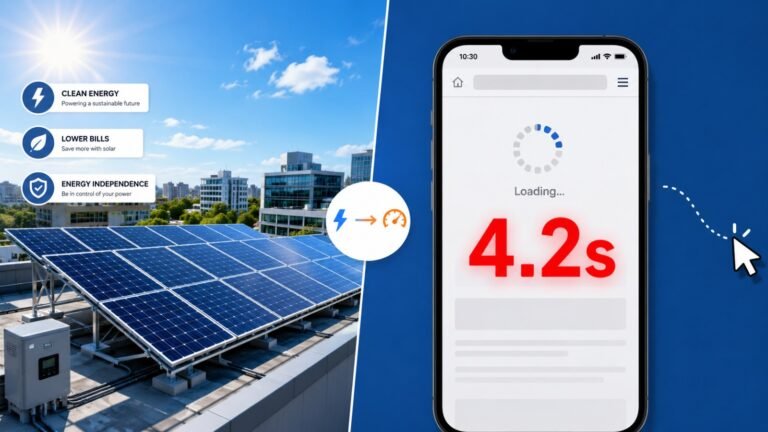
A homeowner searches “solar panel cost,” clicks your ad, and lands on your site. The page takes four seconds to load. They’re gone before your hero image finishes rendering and they never see your financing options, your case studies, or your quote form. This happens on solar websites more than almost any other industry, and most business owners have no idea it’s happening. A slow solar company website can lose potential customers before they request a quote.
The Real Cost of a Slow Solar Website
Speed isn’t a technical vanity metric. It’s a lead-generation problem hiding in plain sight.
Did you know? Google itself has reported that a one-second delay can increase a site’s bounce rate by over 100%. For a solar company running paid traffic, that’s not a UX inconvenience, that’s ad spend disappearing into a page nobody waited to see.
The data across industries is consistent and brutal:
The probability of a visitor leaving a page increases by roughly 32% as load time goes from one second to three seconds
A jump from one to five seconds increases bounce probability by roughly 90%
Just one second of delay can cause up to a 7% drop in conversions
Close to 40% of visitors abandon a site that takes longer than three seconds to load, and roughly 79% of shoppers who have a slow experience won’t come back.
Learn more about our solar website design services.
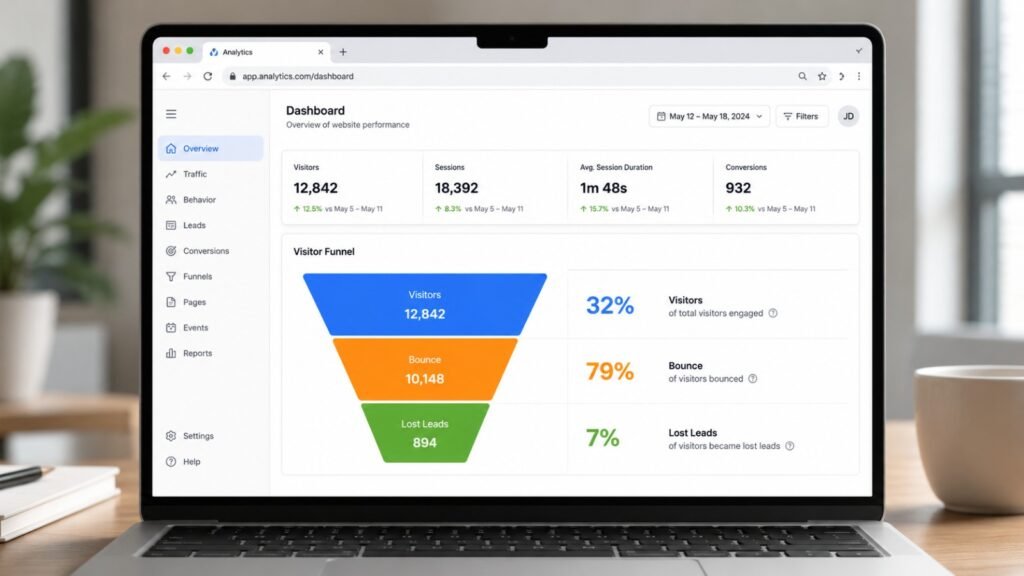
If you’ve never checked these numbers for your own site, that’s the first fix, not the last one.
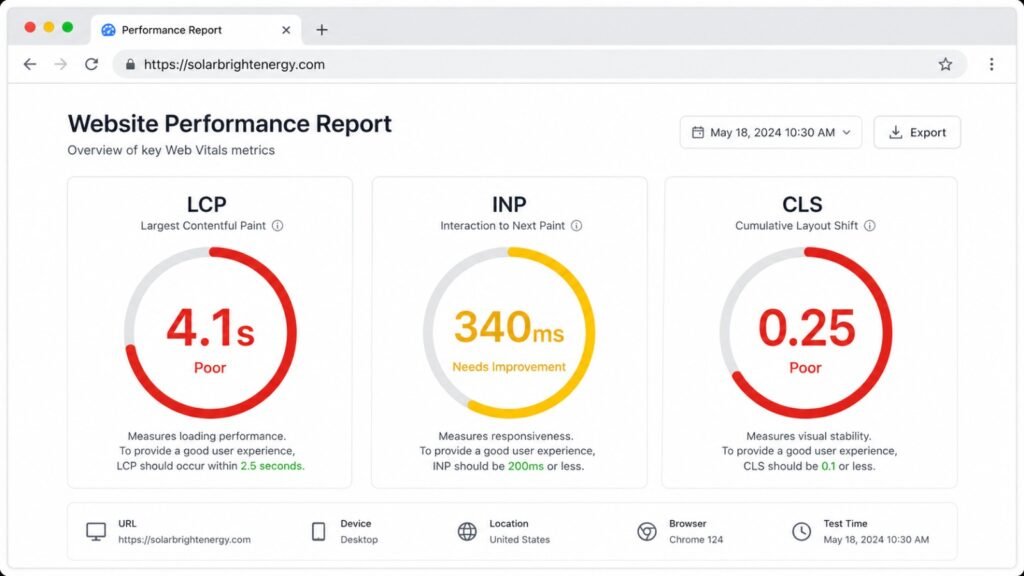
If you’ve never checked these numbers for your own site, that’s the first fix, not the last one.
What "Slow" Actually Means
“Slow” isn’t a feeling, Google measures it with three specific numbers, known as Core Web Vitals:
Largest Contentful Paint (LCP) – how long it takes your biggest visible element (usually a hero image or headline) to load. Should be under 2.5 seconds.
Interaction to Next Paint (INP) – how quickly your site responds when someone taps a button or opens your solar savings calculator. Should be under 200 milliseconds.
Cumulative Layout Shift (CLS) – how much your page jumps around while loading (that maddening moment where you go to tap “Get a Quote” and an ad loads in and you hit the wrong thing instead). Should be under 0.1.
Why Solar Websites Are Especially Prone to Lag
Solar sites carry more technical weight than the average business website, for reasons that are specific to the industry:
Heavy, uncompressed imagery. Rooftop installation photos, before/after shots, and drone footage are the backbone of solar marketing, and they’re also enormous files if nobody compresses them before upload.
Embedded calculators and financing widgets. Solar savings calculators, loan estimators, and net-metering tools are often built on third-party JavaScript embeds that were never optimized for speed. Each one adds render-blocking code.
Stacked marketing plugins. Chat widgets, review-badge plugins, retargeting pixels, popup builders, most solar sites run 8 to 15 of these simultaneously, and each one is a separate network request slowing the page down.
Cheap or shared hosting. A lot of solar companies are still running on entry-level hosting plans meant for a five-page brochure site, not a lead-gen engine with calculators, forms, and heavy media.
No CDN. Without a content delivery network, every visitor, whether they’re in Toronto, São Paulo, Dubai, Singapore, or Sydney, is pulling data from a single server location, adding real latency for anyone far from it.
How Google Punishes Slow Solar Sites
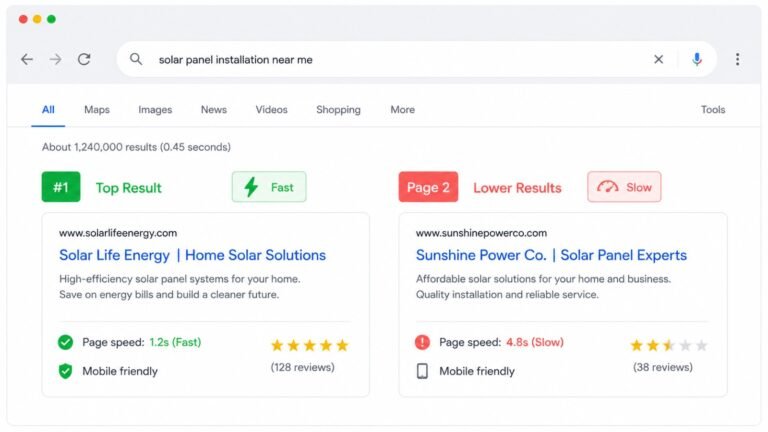
Direct answer: Page experience, including Core Web Vitals, is one of the ranking signals Google’s algorithm evaluates, Google explicitly tracks load performance through Core Web Vitals, and slow-loading sites tend to rank lower and receive less organic traffic as a result. For competitive local terms like “solar installation near me” or “solar panel quotes,” a slow site is competing with one hand tied behind its back before content or backlinks even enter the picture.
It compounds too. A slow site gets fewer return visits, generates weaker engagement signals, and earns fewer natural backlinks all of which are also ranking inputs. Speed isn’t one factor in isolation; it drags several others down with it.
Pro tip: Run your solar site through PageSpeed Insights and GTmetrix side by side. PageSpeed gives you Google’s actual field data (what real visitors experienced); GTmetrix gives you a more detailed lab breakdown of exactly which file or script is the bottleneck. Use both, the first tells you the size of the problem, the second tells you where to fix it.
Our SEO services for solar companies help improve search visibility and organic traffic.
Common Mistakes Solar Companies Make
Our SEO Services for Solar Businesses team sees the same handful of mistakes on nearly every audit:
Uploading camera-resolution images straight to the CMS. A 6MB rooftop photo displayed at 800px wide is pure waste, it should be compressed and served at the size it’s actually shown.
Adding a new plugin for every new marketing tactic. Popup for lead magnets, another for exit-intent, another for reviews, another for chat — each is small alone, but they stack into serious drag.
Treating the homepage like a portfolio. Endless project galleries and video backgrounds look impressive to the business owner and painfully slow to everyone else.
Never testing on mobile data, only office wifi. Most solar leads are researched on a phone, often on cellular data, a page that feels fast on office fiber can be unusable on a 4G connection in the field.
Fixing speed once and never again. Every new plugin, integration, or hero video added six months later erodes the gains from the last optimization pass.
How to Fix It - A Practical Checklist
- Compress and resize every image before upload — modern formats like WebP cut file size dramatically without a visible quality loss.
- Lazy-load anything below the fold — project galleries, testimonials, and footer content shouldn’t load until a visitor scrolls to them.
- Audit every plugin and script — if you can’t name what a plugin does for your conversion rate, remove it and measure the speed gain.
- Move to performance-grade hosting or a CDN — especially important if you’re marketing across multiple countries, since a CDN serves each visitor from the server closest to them.
- Rebuild embedded calculators as lightweight components rather than heavy third-party iframes where possible.
- Set a maintenance cadence — check Core Web Vitals monthly, not once a year after a redesign.
Need help fixing these issues? Get a solar website performance audit.
Expert insight: Based on working with solar and home-services companies across multiple markets, the pattern I see most often isn’t one catastrophic mistake, it’s five or six small ones stacked on top of each other. A slightly heavy hero image, an unoptimized calculator embed, three marketing plugins nobody remembers installing. Individually, none of them feel worth fixing. Together, they’re the reason a solar company’s cost-per-lead creeps up every quarter with no obvious cause.
A Note on Global Solar Markets
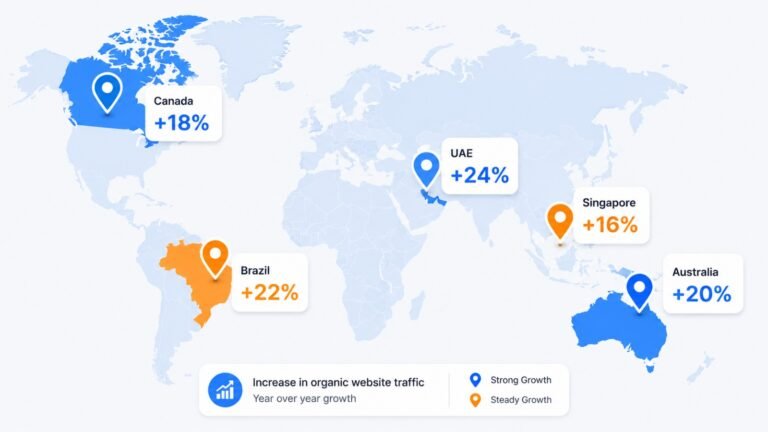
Solar buyers in Canada, Brazil, the UAE, Singapore, and Australia are searching with different intents, Canadian homeowners are often researching provincial rebates, UAE and Singapore searches skew commercial and high-density residential, Brazil’s market is growing fast on distributed generation, and Australia has some of the highest per-capita rooftop solar adoption in the world.
A single page can speak to all of these audiences on the problem of slow, leaky solar marketing sites, but ranking locally in five countries at once genuinely requires dedicated, geo-specific pages per market rather than one page trying to do all five jobs. Worth planning for as a next step once this cluster page is live.
Frequently Asked Questions
1. How fast should a solar company's website load?
Aim for a Largest Contentful Paint under 2.5 seconds and full interactivity within 200 milliseconds of any tap or click. Anything beyond 3–4 seconds starts costing you leads measurably.
2. Does website speed really affect Google rankings for solar keywords?
Yes. Core Web Vitals are part of Google’s page experience signals, and slow pages also tend to generate weaker engagement and fewer backlinks, both of which independently affect rankings.
3. What's the single biggest speed killer on solar websites?
Uncompressed, full-resolution imagery is the most common offender, followed closely by unoptimized third-party calculator and financing widgets.
4. Can I fix website speed myself, or do I need a developer?
Image compression and plugin cleanup can often be done without a developer. Hosting migrations, CDN setup, and rebuilding heavy embeds usually need technical help to do safely.
5. How often should I re-check my site's speed?
Monthly is a reasonable cadence, and always after adding a new plugin, calculator, or major page redesign.
6. Does mobile speed matter more than desktop for solar leads?
Generally yes, most solar research starts on mobile, often on cellular data rather than wifi, so mobile performance deserves priority testing.
7. What tools show me how slow my solar site actually is?
Google PageSpeed Insights (real-world field data) and GTmetrix (detailed technical breakdown) used together give the clearest picture.
Ready to see what your current site is actually costing you in leads? BharatRiseRanks audits solar company websites for exactly these speed and SEO gaps, get in touch for a free technical review.