
SEO Services for Dentists: The Complete Guide to Growing Your Practice Online

A dental practice can be the best in its city and still sit on page three of Google, invisible to the very patients it was built to serve. That gap between clinical excellence and online visibility is exactly what SEO services for dentists are designed to close.
This page is your central hub for understanding dental SEO from the ground up. Each section below covers a subtopic that deserves its own deep dive, and we will be publishing
dedicated guides on many of them. Bookmark this page, because it is the map you will keep coming back to.
What Is SEO for Dentists, and Why Does It Matter?
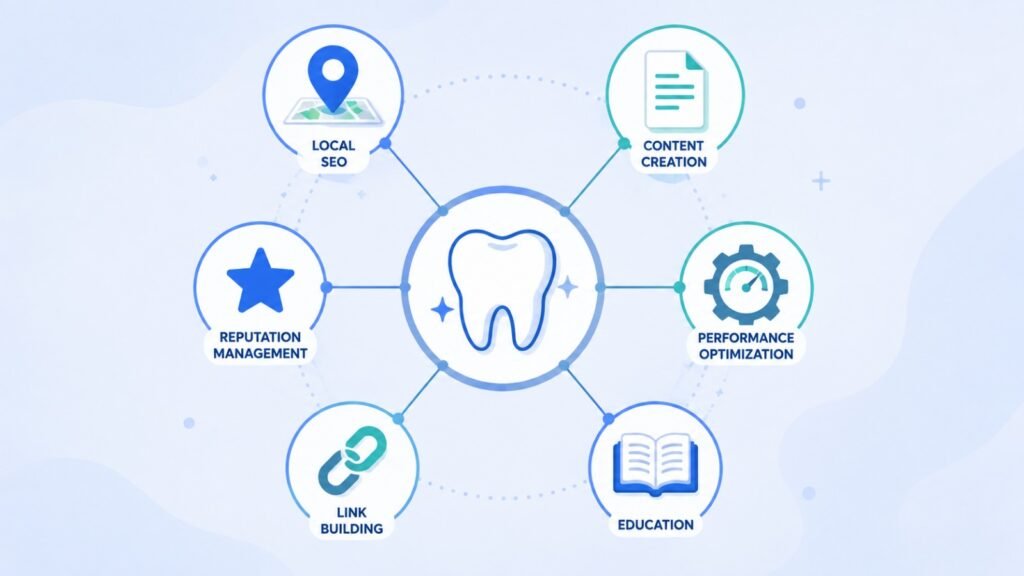
SEO for dentists is the practice of optimizing a dental clinic’s website, local listings, and content so it ranks higher on Google when people nearby search for terms like “dentist near me,” “emergency dentist,” or “teeth whitening in [city].” It combines local search optimization, technical website health, content strategy, and reputation signals into one coordinated system built to bring in new patients on autopilot.
Here is why it matters in plain terms: most patients do not ask a friend for a dentist recommendation anymore. They open Google, look at the map pack, skim a handful of websites and reviews, and pick within minutes. If your practice is not visible at that exact moment, you are not losing a future patient. You are handing that patient, and their lifetime value, to a competitor down the street.
Unlike a billboard or a one-time newspaper ad, SEO compounds. A well-optimized page you publish this year can keep attracting patient inquiries three, four, even five years later, with no additional ad spend. That is the core reason dental clinics treat SEO as infrastructure rather than a marketing expense.
Did You Know? A large share of patients research a dentist online before ever picking up the phone, and most never scroll past the first page of results. If your clinic is not on that first page for your core services and city, you are effectively invisible to a majority of local searchers.
How Patients Actually Search for a Dentist Today
Before we get into tactics, it helps to understand the behavior SEO is built around. A typical patient journey looks something like this:
- A person feels tooth pain or wants a cosmetic fix and types a symptom or service into Google, not a brand name.
- Google shows a local map pack of three clinics, followed by organic website listings.
- The searcher checks star ratings and review count before clicking anything.
- They land on a clinic website and look for the specific treatment, location, and a way to book or call quickly.
- If the site is slow, outdated, or vague about services, they bounce back to Google and try the next result.
Every one of those steps maps directly to a discipline inside dental SEO: local optimization gets you into the map pack, reputation management earns the trust click, on-page content answers the treatment question, and technical performance keeps the patient from bouncing.
The Core Pillars of Dental SEO
Dental SEO is not one task. It is a set of interconnected pillars that reinforce each other. A clinic that only does one of these, say, blogging, without fixing technical issues or claiming its Google Business Profile, will see limited results. The pillars are:
- Local SEO – Getting found for “near me” and city-specific searches.
- On-page SEO – Structuring website content so search engines and patients both understand it.
- Technical SEO – Making sure the site loads fast, works on mobile, and is crawlable.
- Content marketing – Publishing pages and articles that answer real patient questions.
- Link building and authority – Earning credible links and mentions that signal trust.
- Reputation management – Generating and managing reviews across platforms.
We will unpack each of these below, and each will eventually link out to its own detailed cluster page.
Local SEO for Dentists
Local SEO is, by a wide margin, the single most important pillar for a dental practice. Dentistry is a hyper-local service. Nobody flies across the country for a routine cleaning, which means your competition is really just the handful of clinics within a short drive of your location.
Local SEO for dentists includes:
- Optimizing your Google Business Profile with accurate categories, services, and photos
- Building consistent NAP (Name, Address, Phone) citations across directories
- Creating location-specific landing pages if you serve multiple neighborhoods or suburbs
- Earning local backlinks from community organizations, dental associations, and local press
- Structuring content around “near me” and city-plus-service keywords
Pro Tip: Create a dedicated page for every major service, implants, root canals, Invisalign, pediatric dentistry, rather than cramming everything onto one generic “services” page. Search engines reward depth and specificity, and patients searching for a particular treatment want a page that speaks directly to their need.
(We will be publishing a full guide dedicated entirely to Local SEO for Dentists, covering citation building, service-area pages, and map pack ranking factors in depth.)
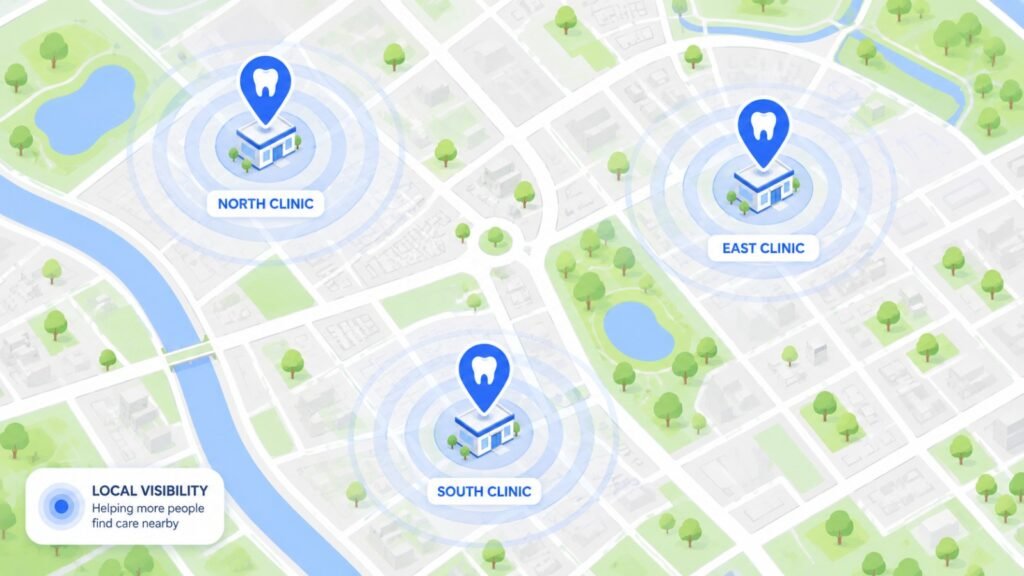
Google Business Profile Optimization for Dental Clinics
Your Google Business Profile is arguably more valuable than your homepage for local visibility. It is the listing that appears in the map pack, in Google Maps, and often directly in search results before any website link.
A properly optimized profile includes complete business hours, accurate service categories, a well-written business description, regularly updated photos of your clinic and team, and a steady stream of patient reviews. Clinics that treat this listing as a “set it and forget it” task consistently lose ground to competitors who post updates, respond to every review, and add new photos monthly.
(A dedicated cluster page on Google Business Profile Optimization for Dentists will cover the exact setup checklist.)
On-Page SEO for Dental Websites
On-page SEO is everything you control directly on your website: page titles, headings, internal links, image descriptions, and the actual written content. For a dental website, on-page SEO should be built around patient intent, not internal jargon.
That means writing page titles the way patients actually search, “Dental Implants in [City]” rather than “Restorative Prosthodontic Solutions.” It means structuring each service page with a clear H1, supporting H2s that answer common questions, and a visible call to action above the fold. It also means every image, before-and-after photos included, has descriptive alt text that helps both accessibility and search visibility.
Common Mistake: Many dental websites list every service on a single crowded page, hoping to rank for dozens of keywords at once. Search engines rarely reward that approach. A focused page for each major treatment, properly interlinked, almost always outperforms a single catch-all page.
(Our upcoming On-Page SEO Checklist for Dental Websites will walk through this page-by-page structure in detail.)
Technical SEO for Dental Practices
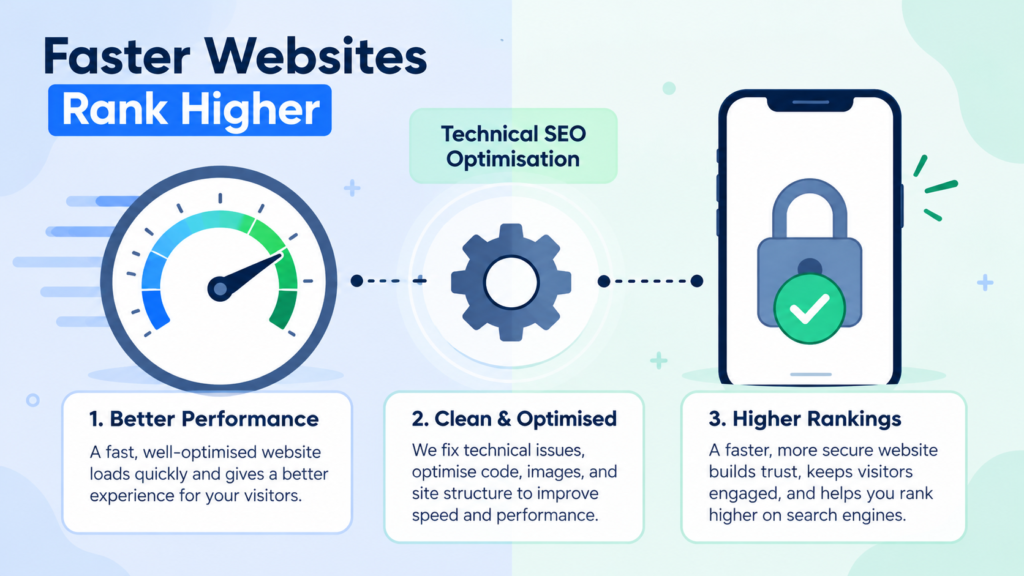
Technical SEO is the unglamorous work happening behind the scenes, and it quietly determines whether your beautifully written content ever gets seen. Key technical factors for dental sites include:
- Page speed: A slow-loading site drives mobile visitors away before they even see your services.
- Mobile responsiveness: The majority of local searches happen on a phone. If your booking button is hard to tap on mobile, you are losing patients.
- Secure connection (HTTPS): A basic trust signal for both patients and search engines.
- Clean site structure: Logical URL paths and internal linking help search engines understand which pages matter most.
- Structured data (schema markup): Helps search engines display your hours, reviews, and services directly in search results.
Expert Insight: In our experience auditing dental websites, the single most common technical issue is a site built years ago on an outdated platform that was never updated for mobile speed. The clinic often has excellent content and strong reviews, yet still underperforms simply because the site takes too long to load on a phone. Fixing that one issue alone often produces a visible jump in rankings within weeks.
For the technical fundamentals behind page speed and mobile usability, Google’s own Search Central documentation is a reliable reference point. (Our dedicated Technical SEO Audit Guide for Dental Sites covers the full checklist we run on every client site.)
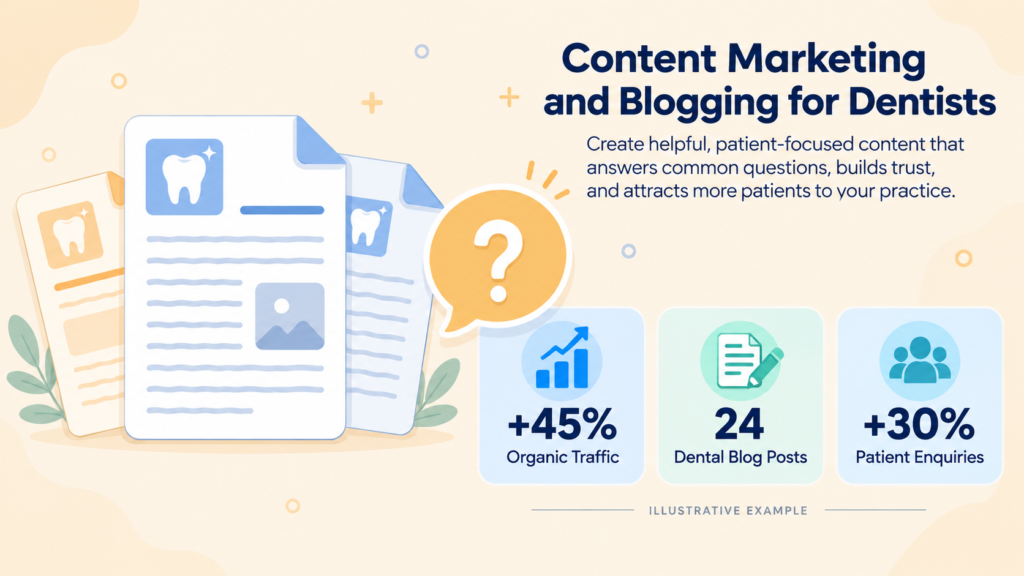
Content Marketing and Blogging for Dentists
Content is how you answer the questions patients are typing into Google long before they are ready to book, and it is how you build topical authority in the eyes of search engines. A dental blog is not about publishing generic “oral hygiene tips” that every other clinic has already written. It is about targeting the specific, high-intent questions your future patients are actually asking, such as “how much do dental implants cost” or “is teeth whitening safe during pregnancy.”
A strong dental content strategy typically includes:
- Treatment-specific guides that double as service pages
- Cost and insurance breakdown articles, since price is almost always a top concern
- Before-and-after case studies with patient consent
- Seasonal or trending topics, like back-to-school orthodontic checkups
(This topic will expand into its own cluster page: Content Marketing Strategy for Dental Clinics.)
Keyword Research for Dental Practices
Keyword research for a dental practice looks different from keyword research for an e-commerce brand. Volume alone is misleading. A keyword with lower search volume but clear buying intent, such as “same day dental implants [city],” is usually far more valuable than a broad, high-volume term like “dentist,” which attracts researchers, students, and job seekers alongside actual patients.
Effective dental keyword research typically groups terms into:
- Transactional keywords: “book a dentist appointment [city],” “emergency dentist near me”
- Commercial investigation keywords: “best cosmetic dentist [city],” “Invisalign vs braces cost”
- Informational keywords: “how long does a root canal take,” “signs you need a filling”
Mapping the right keyword type to the right page is what separates a site that ranks from a site that ranks but never converts.
(See our upcoming guide, Dental Keyword Research: A Practical Framework, for the full process we use to map keywords to pages.)
Link Building for Dental Websites
Backlinks, links from other websites pointing to yours, remain one of the strongest trust signals in search engine algorithms. For dental practices specifically, quality outweighs quantity by a wide margin. A single link from a recognized dental association, a local news feature, or a healthcare directory carries far more weight than dozens of low-quality directory submissions.
Realistic link building tactics for dental clinics include local sponsorships, guest contributions to health publications, partnerships with complementary practices like orthodontists or oral surgeons, and press coverage from community involvement or notable patient outcomes. It’s worth understanding Google’s guidance on link schemes before agreeing to any link building tactics, since manipulative links can trigger a manual penalty.
(Our dedicated guide, Ethical Link Building for Dental SEO, breaks down exactly which tactics we use and which we avoid.)
Online Reviews and Reputation Management
Reviews influence two things simultaneously: your local ranking and your click-through rate once you appear in search results. A clinic with a 4.9 rating and 300 reviews will consistently out-convert a clinic with a 4.2 rating and 20 reviews, even if both rank in the same map pack position.
Reputation management as part of dental SEO involves building a consistent, ethical system for requesting reviews after appointments, responding to every review, positive or negative, in a professional tone, and monitoring review platforms beyond Google, including Facebook and healthcare-specific directories.
Did You Know? Responding to negative reviews thoughtfully and promptly often does more for patient trust than having zero negative reviews at all. Prospective patients tend to trust a practice more when they see how it handles a complaint, not just whether one exists.
Google’s own Google Business Profile Help Center outlines the accepted policies for requesting and responding to reviews. (Our upcoming guide, Online Review Management for Dental Practices, covers the full system we set up for clients.)
SEO for Multi-Location Dental Groups
Practices operating across multiple cities or neighborhoods face a different set of challenges. Each location needs its own optimized Google Business Profile and its own dedicated landing page, ideally with unique content rather than a duplicated template swapped only by city name. Search engines are quick to flag near-identical location pages, which can quietly suppress rankings across the entire group.
Multi-location dental SEO also requires careful internal linking between locations, consistent NAP data across every citation, and often a centralized content hub, much like this page, that funnels authority down to individual location pages.
(A dedicated guide, SEO for Multi-Location Dental Practices, is planned as part of this content cluster.)
SEO vs PPC: What Should a Dental Practice Invest In?
This is one of the most common questions dental clinic owners ask, and the honest answer is that the two serve different purposes rather than competing directly.
Pay-per-click advertising delivers visibility immediately, but that visibility disappears the moment the budget stops. SEO takes longer to build momentum, typically a few months before meaningful traction, but the pages you create keep working long after the initial investment, without an ongoing per-click cost.
Many established practices run both in parallel: PPC for immediate demand and new service launches, SEO for durable, long-term visibility that reduces cost per patient acquisition over time. Clinics with limited budgets often start with SEO precisely because it builds an asset rather than renting attention.
(Our upcoming comparison, SEO vs PPC for Dentists: Where to Invest First, breaks this decision down by budget and market.)
How Long Does Dental SEO Take to Show Results?
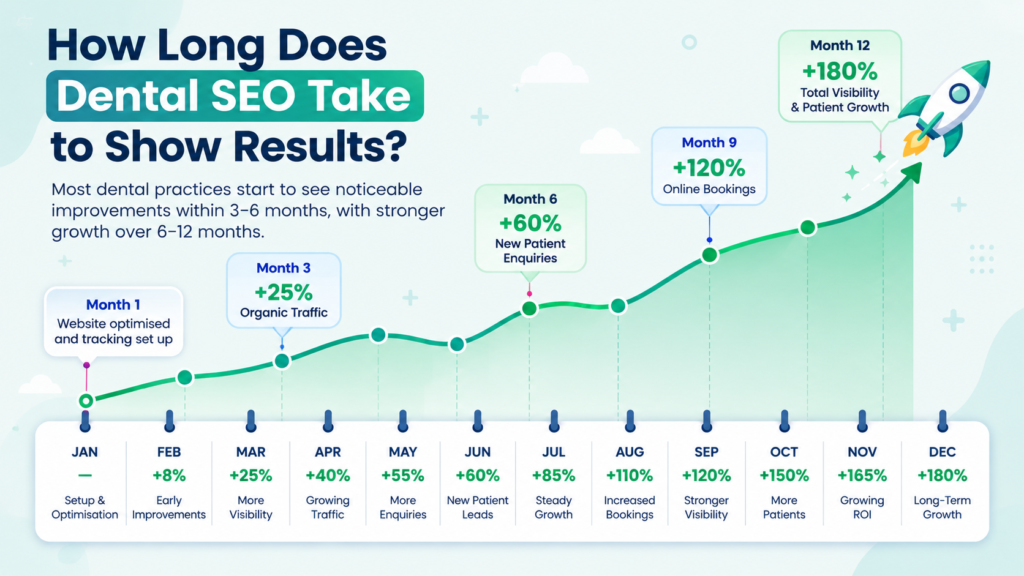
Set realistic expectations from the start. Meaningful movement in local rankings typically begins within two to four months, with more substantial results, higher rankings, increased call volume, and new patient bookings, building over six to twelve months. Practices in less competitive markets often see faster results, while clinics in dense urban areas with many established competitors need a longer runway.
Anyone promising first-page rankings within a week or two is either overpromising or targeting keywords with no real competition, and therefore no real value. For a sense of how heavily individual factors are weighted, annual industry research such as Whitespark’s Local Search Ranking Factors report is a useful, regularly updated reference point.
What Makes the Best SEO Agency for Dentists
Not every SEO agency understands the nuances of healthcare marketing, and dentistry has its own regulatory and trust considerations that generic agencies often miss. The best SEO agency for dentists is not necessarily the one with the flashiest case studies. It is the one that treats your specific city, specialty, and patient base as unique rather than plugging you into a template built for a different industry entirely.
When evaluating a dental SEO partner, look for:
- Verifiable experience with dental or healthcare clients specifically
- Transparent reporting that ties rankings to actual calls and bookings, not vanity metrics
- A clear, ethical link building process, since spammy tactics can trigger penalties that take months to recover from
- A content approach that reflects real clinical accuracy rather than generic filler
- Willingness to explain strategy in plain language rather than hiding behind jargon
Pro Tip: Ask any agency you are considering to show you before-and-after ranking data from an actual dental client, not a generic industry case study. If they cannot produce dentistry-specific proof, they are likely learning the nuances of healthcare marketing on your budget.
(This section expands into its own dedicated cluster page: Best SEO Agency for Dentists, a full breakdown of how to vet and compare providers.)
Why Dental Practices Choose Bharat Rise Ranks
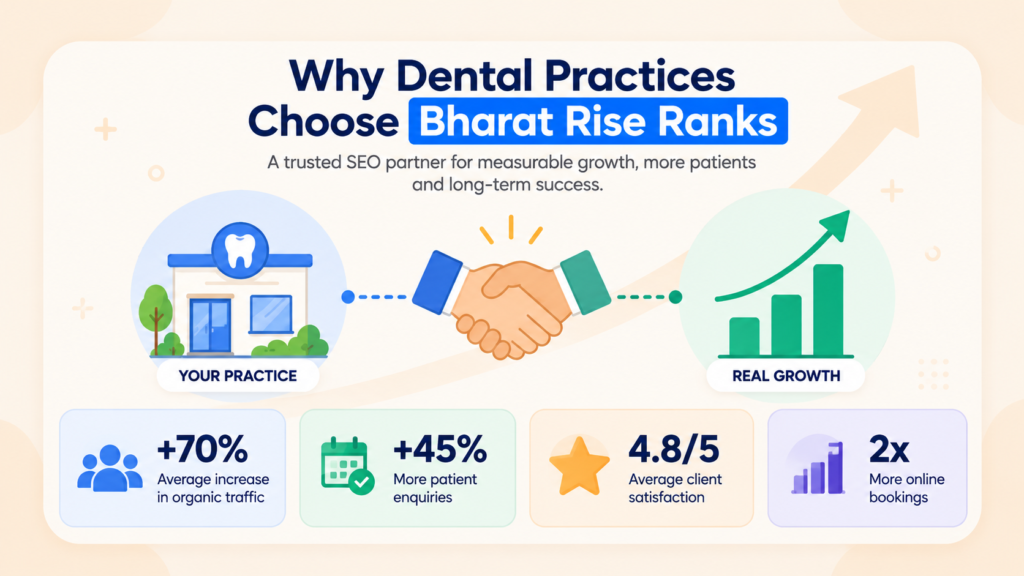
Based on working with clinic owners across competitive local markets, one pattern shows up again and again: the practices that grow fastest online are not necessarily the ones with the biggest marketing budgets. They are the ones with a consistent, patient-focused SEO strategy applied over time, without shortcuts that put their listing at risk.
At Bharat Rise Ranks, we build dental SEO strategies around that principle. Every engagement starts with a full audit of your local listings, website health, and current visibility, followed by a roadmap built around your specific services and city, not a generic template applied to every client. Our reporting connects rankings directly to calls, form submissions, and booked appointments, so you always know what your investment is actually producing.
If you are ready to stop losing patients to the clinic ranking above you, this is where that changes.
Frequently Asked Questions
1. What does dental SEO actually include?
Dental SEO includes local search optimization, Google Business Profile management, on-page content, technical website improvements, link building, and review management, all working together to increase visibility for patients actively searching for dental care.
2. How much do SEO services for dentists cost?
Pricing varies by market size and competition, but most professional dental SEO retainers involve a monthly investment that scales with the scope of work, ranging from foundational local optimization to full-scale content and authority building for multi-location groups.
3. Can I do dental SEO myself, or do I need an agency?
Solo dentists with time and patience can handle basic Google Business Profile optimization themselves. However, technical SEO, content strategy, and ethical link building typically require specialized expertise to execute correctly and avoid costly mistakes.
4. How is dental SEO different from general SEO?
Dental SEO focuses heavily on local intent, healthcare-specific trust signals, and treatment-based keyword targeting, areas that differ significantly from e-commerce or general business SEO strategies.
5. Will SEO help with a brand-new dental practice with no online history?
Yes, though new practices should expect a slightly longer runway to build authority. A strong local SEO foundation, complete Google Business Profile, and early review generation can accelerate visibility significantly.
6. Does SEO work for specialty practices like orthodontics or oral surgery?
Absolutely. Specialty practices often benefit even more from targeted SEO, since patients searching for specific procedures tend to have high intent and are actively comparing providers before booking a consultation.
7. What is the biggest mistake dental practices make with SEO?
Treating it as a one-time project rather than an ongoing strategy. Search rankings require consistent maintenance, fresh content, and active reputation management to hold position against competitors who are also investing in SEO.
8. How do I find the best SEO agency for dentists?
Look past general marketing agencies and prioritize one with a documented track record in dental or healthcare SEO specifically. The best SEO agency for dentists will show you real ranking and patient-inquiry data from other dental clients, explain its process in plain language, and build a strategy around your city and specialties rather than a one-size-fits-all package.