
Local SEO Checklist for Solar Installers (Free Download)

A homeowner in Dubai searching for “solar panel installation near me” is unlikely to scroll through pages of search results. They’re usually choosing from the businesses appearing in the Google Maps local pack, the first few companies they see, trust, and contact. If your solar installation company isn’t visible there, you can lose valuable leads before they ever reach your sales team.
That’s exactly what this local SEO checklist for solar installers is designed to help you fix. Local SEO for solar companies isn’t about stuffing your website with keywords or trying to rank nationally. It’s about getting your business in front of customers in the cities and service areas where you actually operate.
When someone searches for solar installation, solar panels, or solar companies in your area, you want your business to be visible, credible, and easy to contact—whether they find you through Google Maps, local search results, or your website.
We created this checklist after auditing dozens of solar company websites across the UAE and seeing the same local SEO problems again and again: incomplete Google Business Profiles, inconsistent business information across directories, weak location pages, missing local content, and websites that aren’t properly optimized for the areas they serve.
These may seem like small issues, but together they can make it much harder for potential customers to find your business—and can cost solar installers qualified leads every month.
Use this checklist to identify the gaps in your local SEO strategy for your solar business, improve your Google visibility, strengthen your local presence, and turn more searches into enquiries.
If you’d rather have it handled for you, our team provides dedicated local SEO services for solar businesses, including local SEO audits, Google Business Profile management, location optimization, and ongoing SEO improvements.
Local SEO Checklist for Solar Installers
The downloadable PDF covers six action areas, each broken into checkable line items your team can work through in a single afternoon:
- Google Business Profile optimization (the highest-leverage fix on this list)
- NAP consistency audit across 40+ directories relevant to the UAE market
- Location page structure and internal linking
- Review generation and response templates
- Citation building priorities
- Content topics based on actual solar buyer questions
Below, we’ll walk through the reasoning behind each section so you understand why it matters, not just what to tick off.
Step 1: Optimize Your Google Business Profile
If you do nothing else on this list, do this. Your Google Business Profile (GBP) is the single biggest factor in whether you show up in the local map pack, and most solar installers set theirs up once and never touch it again. Our Local SEO Services page breaks down exactly how we handle this for clients.
Did You Know? According to Google’s own guidance on improving local ranking, ranking weighs three factors, relevance, distance, and prominence, and prominence is heavily influenced by how complete and active your GBP listing is, not just how many reviews you have.
What actually moves the needle:
- Primary category set to “Solar Energy Contractor” (not just “Contractor” or “Energy Supplier”)
- Service areas listed precisely, Dubai, Abu Dhabi, Sharjah, or whichever emirates you actually cover
- Weekly posts showing recent installations, promotions, or company updates
- Q&A section seeded with the questions you get most often on sales calls
- Photos uploaded regularly, before/after installation shots outperform stock imagery
Pro Tip: Upload photos with geotagged EXIF data where possible. It’s a small signal, but it reinforces location relevance to Google’s algorithm alongside everything else on your profile.
Step 2:Keep Your NAP Information Consistent
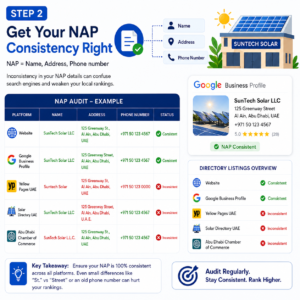
NAP stands for Name, Address, Phone number, and inconsistency here is one of the quietest ranking killers we see. If your business is listed as “SunTech Solar LLC” on your website, “Suntech Solar” on a directory, and has an old phone number on a third listing, Google treats these as weaker signals of a legitimate, established business.
Run an audit across your website, Google Business Profile, and every directory you’re listed on, Yellow Pages UAE equivalents, industry-specific solar directories, and Chamber of Commerce listings. Every instance should match exactly, down to abbreviations like “St.” versus “Street.”
Step 3: Create Location-Specific Solar Landing Pages
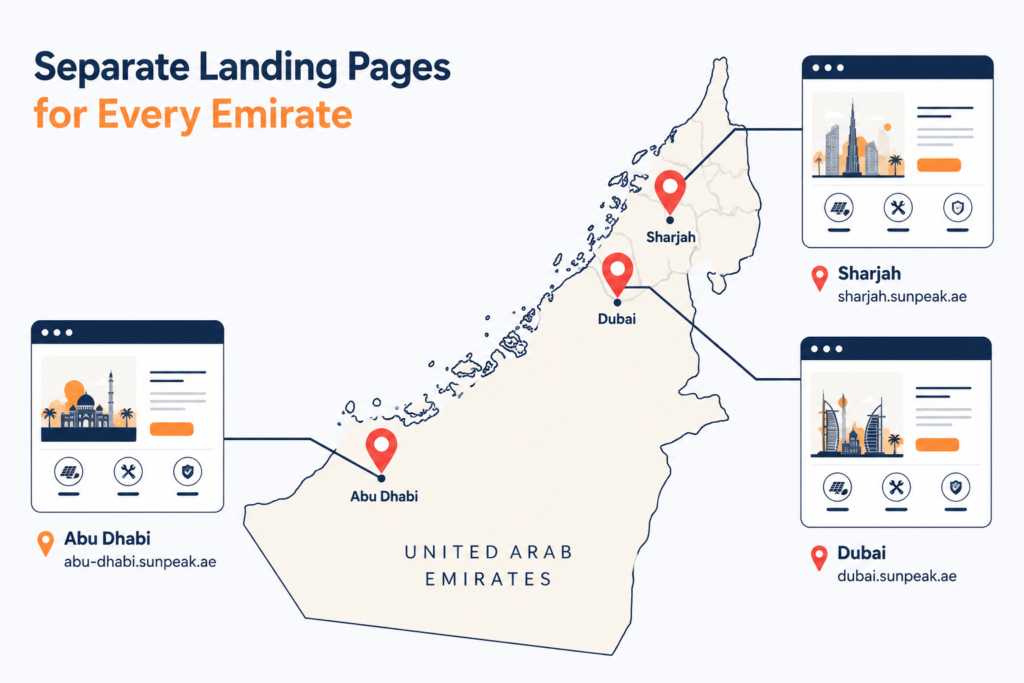
A single “Our Services” page trying to rank for every emirate you serve is fighting an uphill battle. Search engines reward specificity. If you install solar systems in both Dubai and Abu Dhabi, each deserves its own page with genuinely different content, local case studies, region-specific incentive information, and mentions of neighborhoods or districts you’ve worked in.
Expert Insight: From what we’ve seen working with installers across multiple markets, the mistake isn’t skipping location pages entirely, it’s building them and then copy-pasting the same 300 words with the city name swapped. Google recognizes this pattern quickly, and thin, duplicate-feeling pages rarely hold rankings for long.
Each location page should answer: What does installation typically cost in this area? What local permits or utility processes apply? What’s the average payback period given regional sun exposure and electricity rates?
Step 4: Collect and Respond to Customer Reviews
Reviews are a ranking factor and a conversion factor simultaneously. A solar installer with 120 reviews at 4.8 stars will consistently outrank and outconvert one with 12 reviews, even if the second company’s work is equally good.
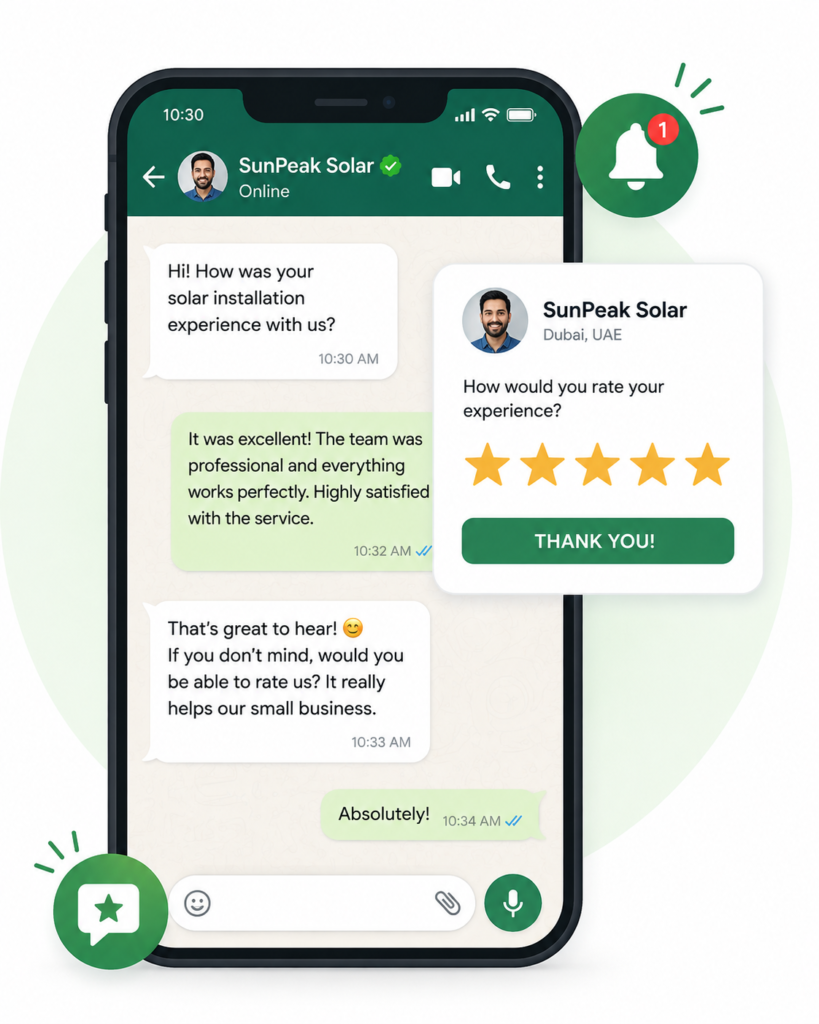
Build review requests into your operational workflow, the moment right after a successful installation and system activation, when the customer’s satisfaction is highest. A simple SMS or WhatsApp message with a direct Google review link outperforms email in our experience, given how UAE consumers typically communicate.
Respond to every review, positive or negative, within 48 hours. Responses to negative reviews matter more than people assume, prospective customers read how you handle complaints as a signal of how you’ll handle their project if something goes wrong.
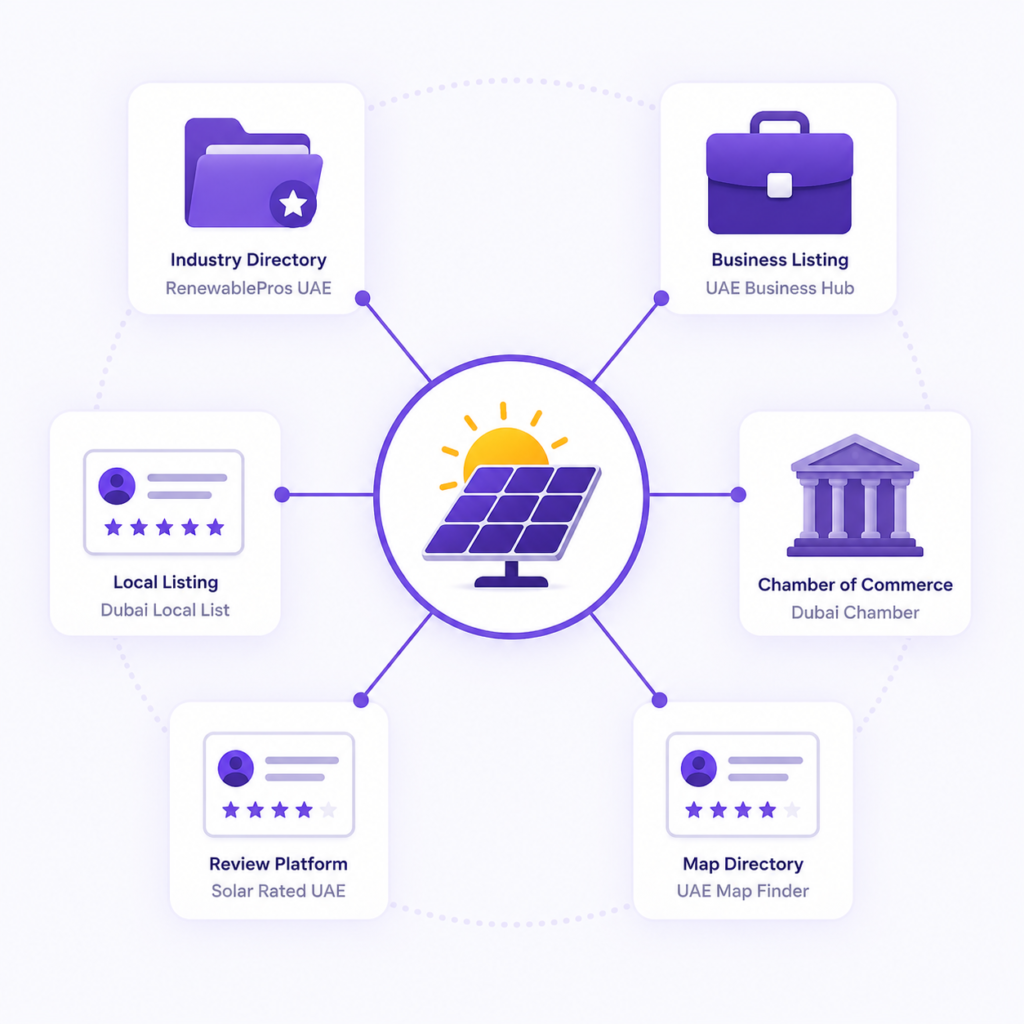
Step 5: Build Local Citations
Not all directory listings are equal. Generic global directories carry less weight than region-specific and industry-specific ones. For UAE solar installers, prioritize:
- Local business directories tied to specific emirates
- Renewable energy and solar industry associations
- Chamber of Commerce listings
- Trade licensing body directories where public listings are available
Common Mistake: Installers often submit to 50+ generic directories in one batch using automated tools, then wonder why nothing changed. Twenty relevant, accurate, industry-specific citations outperform two hundred generic ones every time.
Step 6: Publish Content That Answers Customer Questions
This is where most solar company blogs go generic, posts about “the benefits of solar energy” that could apply to any country on earth. That content doesn’t rank locally because it doesn’t answer local questions. Our content strategy service is built around closing exactly this gap.
Instead, build content around what your actual leads ask before booking a consultation: financing options specific to the region, net metering policies like Shams Dubai, expected ROI given local electricity tariffs, and maintenance considerations for the local climate. This is also the content most likely to get picked up in AI-generated search summaries, since it directly answers a specific, well-defined question rather than speaking in generalities.
Common Mistakes Solar Installers Make With Local SEO
- Treating the website as a brochure instead of a lead-generation tool with clear calls to action on every page
- Ignoring mobile page speed, even though most local searches happen on phones
- Letting the GBP listing go stale after the initial setup
- Focusing entirely on backlinks while neglecting on-page and local signals that matter more for map pack rankings
- Skipping schema markup, which helps search engines understand your service areas and offerings