
Residential vs Commercial Solar SEO: Why You Need Different Pages
Why Residential and Commercial Solar Need Different SEO Pages
A homeowner searching for solar panels and a facilities manager sourcing a commercial installation are not looking for the same thing, reading the same way, or ready to buy on the same timeline. Yet most solar company websites run both audiences through a single “Solar Solutions” page, then wonder why it ranks for neither residential nor commercial terms with any real strength.
This isn’t a copywriting problem. It’s a search intent problem, and it’s costing solar businesses in Canada, Brazil, the UAE, Singapore, and Australia real pipeline every month.

Why Solar Companies Keep Losing Rankings on Both Fronts
Residential and commercial solar SEO fail together for one core reason: they’re competing against pages built for a single, sharply defined audience. When a homeowner in Toronto searches “solar panel cost for home,” Google is comparing your blended page against a competitor’s dedicated residential page, one with home-specific pricing, incentive breakdowns, and rooftop case studies. Your page loses on relevance before it even gets evaluated on content quality.
The same happens in reverse. A procurement manager searching “commercial solar ROI calculator” isn’t interested in reading about rooftop aesthetics or family energy bills. They want capacity planning, tax depreciation schedules, and case studies with kilowatt figures and if that’s buried under residential messaging, they bounce.
The Core Problem: One Page, Two Buyers
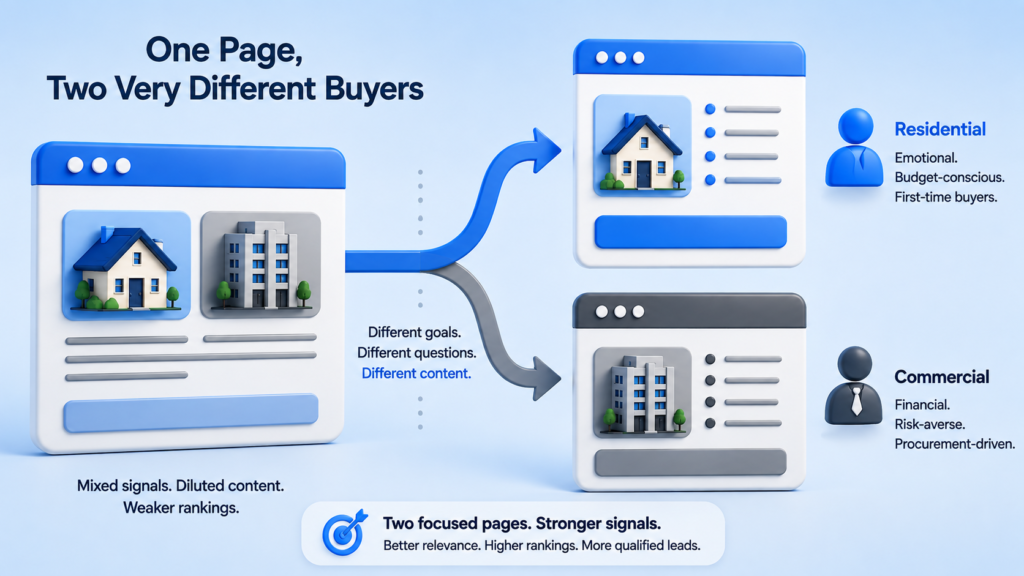
Google’s ranking systems increasingly reward topical depth over topical breadth. A page trying to serve both audiences dilutes its signals, it can’t build the semantic density needed to be seen as the definitive answer for either query cluster. Splitting the content isn’t a nice-to-have; it’s what lets each page compete for its actual SERP.
There’s also a trust dimension. Residential buyers are emotional, budget-conscious, and often first-time energy purchasers. Commercial buyers are financial, risk-averse, and evaluating vendors against procurement criteria. A single tone can’t credibly speak to both without feeling generic to one side.
Keyword Divergence: Why “Solar Panels” Isn't a Strategy
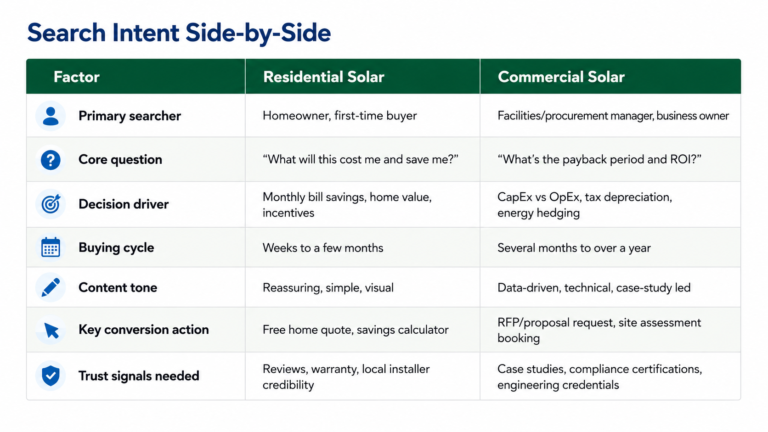
Did You Know? Search intent for “solar” splits sharply by modifier. Terms like “solar panels for my house” and “residential solar installer near me” carry consumer intent, while “commercial solar EPC” and “industrial solar financing options” carry B2B procurement intent and Google’s SERP features (local packs vs. informational snippets) differ accordingly, meaning the ranking playbook differs too.
Residential-intent keywords cluster around cost, savings, home value, and local installers. Commercial-intent keywords cluster around scale, financing structures (PPA, lease, outright purchase), depreciation, and vendor credentials. Trying to rank one page for both means diluting keyword density for each cluster, which is exactly what suppresses rankings on competitive terms.
Content Depth Each Page Actually Needs
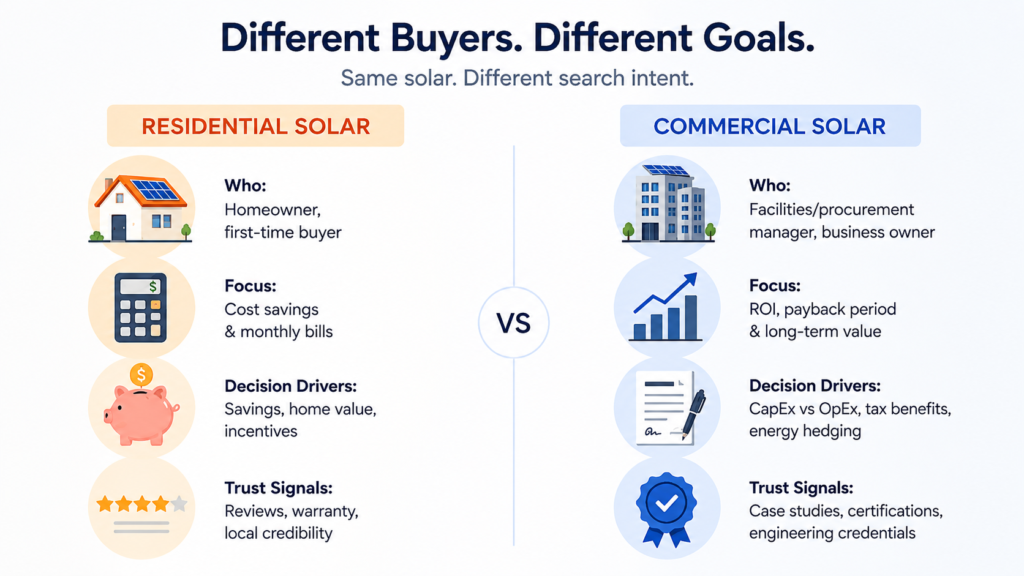
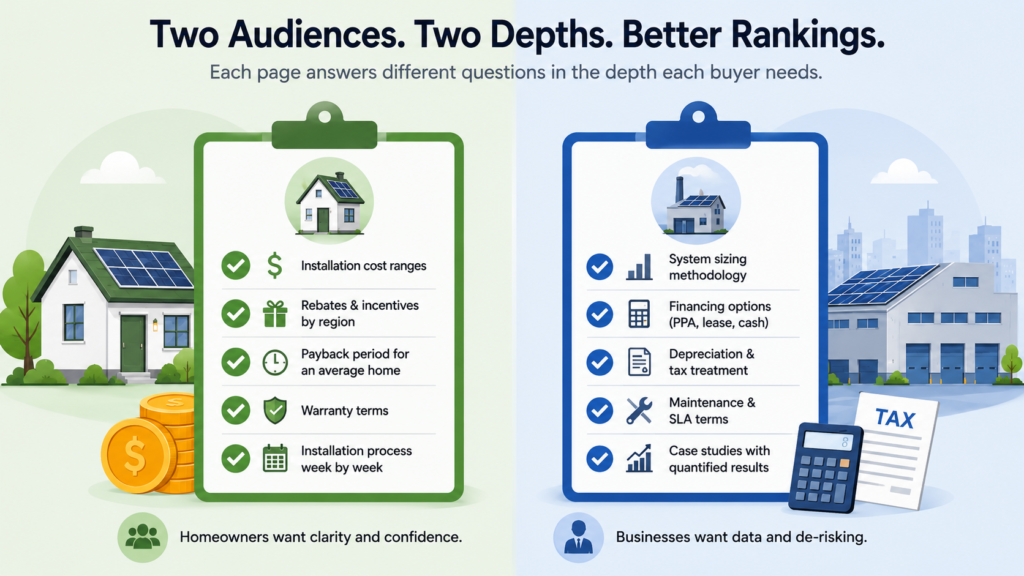
A residential solar page earns rankings by answering: installation cost ranges, available rebates/incentives by region, payback period for an average home, warranty terms, and what the installation process looks like week by week.
A commercial solar page earns rankings by answering: system sizing methodology, financing options (PPA vs. lease vs. cash purchase), depreciation and tax treatment, maintenance/SLA terms, and case studies with quantified outputs — kilowatt-hours generated, dollars saved annually, payback in months.
Neither depth can live comfortably inside the other without one audience skimming past content that isn’t for them.
Conversion Paths Are Not the Same
Residential visitors convert on low-friction actions: a savings calculator, a “get my free quote” form, or a phone call after seeing local reviews. Commercial visitors convert on higher-friction, higher-trust actions: requesting a formal proposal, downloading a case study, or booking a site assessment call with an engineer. Putting a residential-style “quick quote” form in front of a facilities manager evaluating a six-figure project signals the vendor isn’t built for enterprise work and that alone can cost the deal.
Common Mistakes Solar Companies Make
- Merging both audiences into one “Solar Services” page and hoping internal navigation sorts it out
- Using residential pricing language (“as low as $X/month”) on commercial pages, which undercuts perceived seriousness for large projects
- Skipping financing-structure content on commercial pages — PPA and lease options are often the deciding factor, not sticker price
- Reusing the same testimonials across both pages instead of pairing homeowner reviews with residential content and case studies with commercial content
- Targeting the same primary keyword on both pages, which creates internal keyword cannibalization and confuses Google about which page to rank
How to Structure Your Two Pages
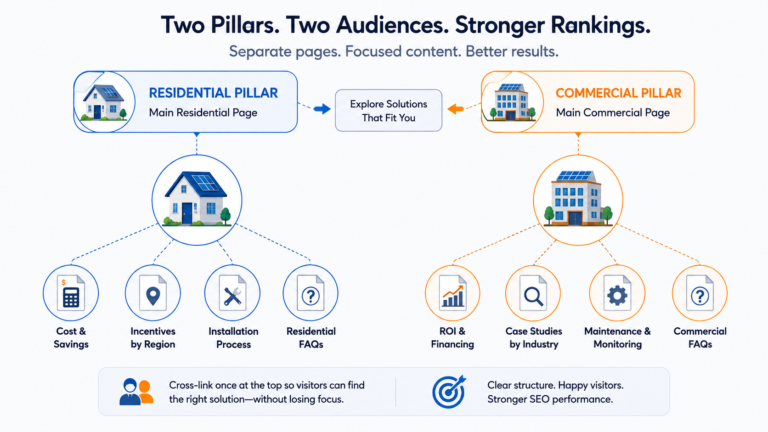
Pro Tip: Build residential and commercial as separate pillar pages, each with its own supporting cluster content, not as tabs or sections on one URL. Google indexes and ranks URLs, not tab states.
For the residential pillar: dedicated pages for cost/savings, incentives by region, the installation process, and residential FAQs, all internally linked back to the main residential page.
For the commercial pillar: dedicated pages for ROI/financing, case studies by industry, maintenance and monitoring services, and commercial FAQs, internally linked back to the main commercial page.
Cross-link the two pillars once, near the top, so a misrouted visitor can self-correct without either page losing topical focus.
Multi-Market Considerations
Expert Insight — Based on running SEO for solar and renewable energy clients across multiple regulatory environments, one pattern shows up consistently: the residential-vs-commercial split matters even more once you’re operating across borders. A residential incentive structure in Australia’s state-based rebate system looks nothing like Canada’s federal and provincial mix, the UAE’s DEWA-driven commercial incentives, Singapore’s high-density commercial rooftop constraints, or Brazil’s net-metering rules. Trying to generalize incentive language across five markets on a single page usually means the content is accurate nowhere. Separate residential and commercial pillars per market — or at minimum, clearly labeled regional sections within each pillar — let you speak specifically instead of vaguely.
If you operate in Canada, Brazil, the UAE, Singapore, and Australia, the residential/commercial split should be your first content decision, and market-specific incentive and regulatory detail should be the second. Skipping straight to keywords without this structure is why many solar businesses plateau in rankings despite steady content output.

Frequently Asked Questions
Do I really need two separate pages, or can strong internal sections work?
Separate URLs perform better because Google ranks and indexes at the page level. Sections on one page compete against each other for the same ranking signals instead of building two distinct topical authorities.
Which page should I build first, residential or commercial?
Build whichever matches your higher-margin or higher-volume business line first, then expand. Most solar companies see faster ranking movement on residential terms due to higher search volume, but commercial terms often convert at higher deal values.
Can one blog cluster support both pillars?
No, each pillar needs its own supporting cluster (FAQs, cost guides, case studies) that links back to its respective pillar page. Shared blog content should link to whichever pillar is contextually relevant, not both equally.
How long does it take to see ranking improvement after splitting the pages?
Typically 2–4 months for initial movement and 6+ months for competitive commercial or residential terms, depending on market competitiveness and domain authority.
Should pricing be shown on commercial solar pages?
Show pricing structure (financing options, typical range by system size) rather than fixed numbers, commercial buyers expect a proposal process, and rigid pricing can undercut perceived customization.
Do residential and commercial pages need different backlink strategies?
Yes. Residential pages benefit from local business directories, review platforms, and community/local news mentions. Commercial pages benefit more from industry publications, B2B directories, and case-study features on partner or manufacturer sites.
Not sure whether your residential and commercial pages should be split right now, or how to structure them if you do? Get My Free Solar SEO Audit and get a clear plan for both pillars.